Diamond Girdle Thickness, Durability Versus Hidden Weight
By Josh Allen, Co-Founder of YourDiamondGuys.com. Fifth generation diamantaire with 30+ years in the global diamond trade. Former supplier to Tiffany & Co., Cartier, and Harry Winston.
How we evaluate proportions: We start with the GIA girdle description, check how thickness changes around the outline, then inspect vulnerable points, spread, and the intended setting. Durability and hidden weight have to be judged together.
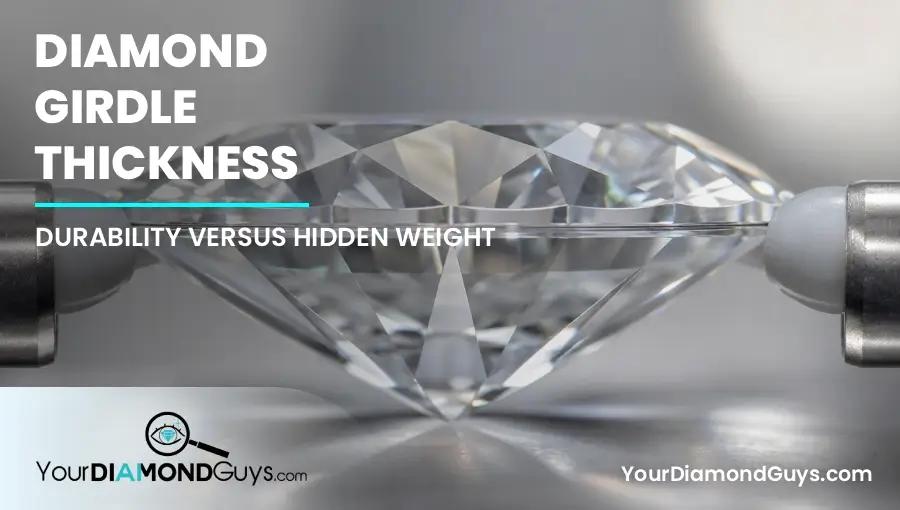
Here is the girdle tradeoff, a very thin edge raises durability risk, while a very thick edge hides carat weight and reduces face up spread.
Too thin and vulnerable areas can chip. Too thick and you pay for carat weight that adds little face up size. The safe answer lives between those extremes and changes with shape.
In the trade, a thick make is easy to feel after you compare enough stones. The weight sounds impressive. The millimeters do not.
For natural diamonds, start with GIA. GIA shows how girdle and culet descriptions can limit round cut quality, because the girdle affects durability and weight ratio, not just the line on a diagram.
The Short Answer
For most modern rounds, a Thin to Slightly Thick, Medium to Slightly Thick, or similar balanced girdle range can work when the variation is gradual. Extremely Thin areas and Very Thick to Extremely Thick sections deserve closer review.
Fancy shapes need more local judgment. Points and corners often require enough material for durability, while broad thick sections along the belly can hide weight. Read the full minimum to maximum description and inspect where each extreme sits.
What The Girdle Description Means
The girdle forms the perimeter where crown and pavilion meet. GIA describes thickness from the thinnest to thickest observed area, so a report can read Thin to Thick or Very Thin to Very Thick.
That range matters more than one average. A single localized thick area at a cushion corner does not behave like a uniformly thick round. A tiny Extremely Thin section at a pear tip matters more than the same word buried in an otherwise safe description.
The measurements guide and depth guide help show whether the girdle adds invisible mass.
Durability And Weight Pull In Opposite Directions
A very thin edge has less material to absorb an impact. Risk rises at exposed points, corners, and areas near surface reaching inclusions such as a bruise, chip, cavity, knot, etched channel, or indented natural.
A thick girdle adds protection in some locations but can trap weight around the perimeter. It can also make setting work harder when thickness changes abruptly.
| Girdle description | Main concern | Buyer response |
|---|---|---|
| Extremely Thin | Elevated chip risk | Locate the area and review setting protection |
| Very Thin | Durability concern in exposed zones | Check points, corners, and inclusions |
| Thin to Slightly Thick | Often workable | Confirm gradual variation and normal spread |
| Medium to Slightly Thick | Comfortable general zone | Still inspect shape specific extremes |
| Thick to Very Thick | Hidden weight and setting fit | Compare millimeters and price |
| Extremely Thick | Major invisible weight risk | Demand a clear shape or durability reason |
Shape Changes The Girdle Decision
Rounds distribute the edge evenly, so abrupt or extreme thickness stands out. Ovals can thicken at the ends. Cushions often show corner variation. Pears and marquises need special protection at points. Princess cuts need secure corners and the right prongs.
Use the outline quality guide beside the girdle call. A bulging belly plus a thick girdle can carry a surprising amount of weight without improving the outline.
For a pear, marquise, heart, or princess, ask where the thinnest point sits. A verbal range without location leaves the most important durability question unanswered.
The Setting Is Part Of The Answer
A protected bezel or well placed V prong can reduce exposure at vulnerable points. It cannot repair an existing chip or turn an extremely thin edge into a carefree choice.
Ask the setter to review the loose stone before final mounting. The head must match the exact millimeters, girdle thickness, and corner geometry.
A secure setting protects a good decision. It should not become an excuse for buying a diamond with obvious structural risk.
How I Judge The Girdle
I mark the girdle minimum and maximum, then locate the extremes in magnified images. Next I compare face up spread and total depth with similar stones.
A wide variation stays only when the shape explains it and the setting can protect it. A thick girdle stays only when the visible size and price remain fair.
A Hidden Girdle Weight Example
Oval A weighs 1.50 carats and has a Medium to Very Thick girdle with heavy sections along the belly. Oval B weighs 1.42 carats and has a Thin to Slightly Thick girdle with similar length and width.
Oval B gives nearly the same footprint with less hidden perimeter weight. I still inspect bow tie and outline, but the girdle has already explained why Oval A needed more carat to look the same size.
Mistakes I Would Avoid
- Reading only the thickest girdle word and ignoring the thinnest.
- Assuming a thick girdle always improves durability.
- Ignoring the location of an Extremely Thin area.
- Paying for hidden girdle weight at a carat threshold.
- Choosing a setting before checking the actual edge and corner geometry.
Questions To Ask Before Buying
- What is the full minimum to maximum girdle description?
- Where are the thinnest and thickest areas located?
- Do any risky inclusions reach the girdle?
- Does the thickness reduce face up spread?
- Will the setting protect the points and corners?
Where To Compare The Proof
Affiliate disclosure: Your Diamond Guys can earn a small commission if you buy through a partner link. It does not change what you pay or which diamond we recommend.
Compare report diagrams, measurements, and magnified videos on Blue Nile and Ritani. Look for similar shapes with different girdle ranges so you can see what the extra weight buys.
The Girdle Range I Would Accept
Look for a balanced girdle with no unexplained extreme. The right range protects the edge without stealing visible size.
On pointed and cornered shapes, location matters more than a comfortable average. Get the loose stone reviewed before the setting is built.
If you want another set of eyes on the stone, book your free consultation with Your Diamond Guys.
Connect The Edge To The Rest Of The Stone
Use the established diamond girdle thickness guide for the broad grading decision. Then check the culet, the princess corner and pavilion guide, and the full red flag screen.
Use the central diamond proportions guide to connect girdle thickness with depth, spread, culet, outline, and setting durability.
Discover the Secrets of the Round Brilliant Cut Diamond
Questions? Reach out directly for a free consultation, or drop them in the Diamond Buyers Academy community — Rob and Josh answer personally.
Questions Buyers Ask Us
*Some links on our site may earn us a small commission at NO EXTRA cost to you, helping us keep our content free*